How to Create Event Sponsorship Packages That Sponsors Actually Want
Event sponsorship packages are one of the most scrutinized—and highest-potential—revenue tools available to event organizers today. According to Event Academy, 88.4% of event marketers identify sponsorships and partnerships as their most effective revenue driver, far outpacing every other revenue stream. Yet acquiring them remains one of the top challenges organizers face, and the pressure to craft event sponsorship packages that actually convert is real. But what many organizers miss is that landing a sponsor is only half the battle. The real goal is building a partnership that delivers measurable value, the kind that keeps sponsors coming back year after year.
Today’s sponsors aren’t just writing checks for logo placements and podium shout-outs; they want qualified leads, documented ROI, authentic engagement opportunities, and partnerships that align with their brand values and business objectives. This guide will show you how to design, price, and pitch event sponsorship packages that deliver for both your sponsors and your bottom line.
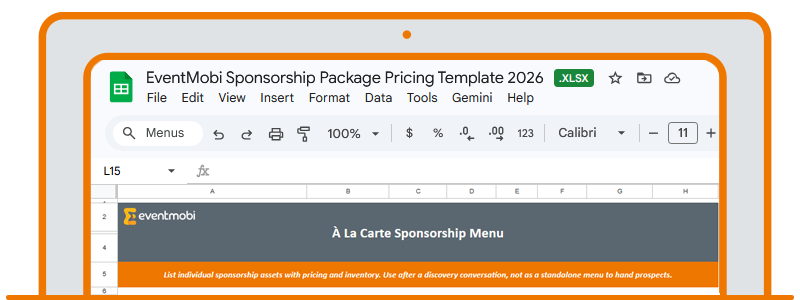
Stop guessing on pricing. Download the EventMobi Event Sponsorship Package Pricing Template and walk into every sponsor conversation with confidence.
What Are Event Sponsorship Packages?
Quote block | An event sponsorship package is a structured collection of marketing benefits and engagement opportunities that an event organizer offers to a potential sponsor in exchange for financial or in-kind support. Packages typically include multiple sponsorship tiers or levels, each with distinct benefits calibrated to different sponsor budgets and business goals.
Event sponsorship packages are collections of marketing services and benefits offered by an event organizer to potential sponsors. They typically include various sponsorship tiers or levels, each with distinct benefits designed to attract sponsors of different sizes and budgets. Think of a sponsorship package less as a product catalog and more as a business proposal, one that makes a clear case for why your event is the right investment to help a sponsor achieve their specific goals.
Before you can design a package worth buying, you need to understand what sponsors are actually buying for (hint: it’s not goodwill or logo real estate).

To start, think like a sponsor! Consider what goals your event sponsors might be hoping to achieve by supporting your event, including:
- Spreading the word about a new product launch
- Reaching out to a new target audience
- Increasing brand awareness with an existing audience
- Building relationships and engaging with a relevant community
- Repositioning a brand that has become stagnant
- Aligning with corporate social responsibility (CSR) and ESG initiatives
- Establishing thought leadership within their industry
- Data-driven lead generation with qualified, scored leads
Why Sponsors Say Yes (and Why They Don’t Come Back)
Sponsorship competes directly with digital, social, media, and experiential channels for budget, which means brands evaluate every opportunity through a strategic lens. The top factors that drive sponsor investment decisions come down to three things: audience alignment and access, a direct line to business goals, and tangible engagement opportunities. Sponsors need confidence that your event reaches the right people, not just in size but in quality, and that the assets you’re offering connect clearly to their KPIs. Most sponsors also don’t have the bandwidth to design activations from scratch, so organizers who come to the table with clear engagement concepts reduce friction and accelerate decision-making.
What organizers tend to overemphasize is the event itself. While history, scale, and prestige matter, they’re not a value proposition in and of themselves. Generic decks that try to appeal to everyone rarely resonate with anyone.

— Brad McCabe, co-founder and managing director, Sponsor Circle
What Should a Sponsorship Package For Events Include?
Regardless of which model you use, every sponsorship package should cover the same core bases:
- Information about your organization, including values, mission, and goals
- Event details such as programming schedule, date, and expected attendance
- Audience data and demographics, including attendee insights and behavioral data
- Sponsorship benefits, expected ROI, and pricing
- ROI measurement methodology and post-event reporting approach
- Event sponsorship package examples or results from previous events
- Visual elements that tie all the information together
Think of these as the non-negotiables. From there, your structure—whether tiered, à la carte, or fully customized—determines how you build on top of them.
Tiered, À La Carte, or Custom: Which Sponsorship Model Is Right for You?
There’s no one-size-fits-all approach to structuring sponsorship packages, but one principle holds across the board: let strategy, not convention, drive your structure.
When Tiered Packages Work (and When They Don’t)
The classic Platinum/Gold/Silver/Bronze model is familiar, easy to communicate, and helpful for internal efficiency. It gives sponsors a way to understand their relative positioning and gives organizers a clean framework for managing inventory and recognition.

A useful litmus test: the number of sponsors at each level should form the shape of a pyramid, fewer at the top and progressively more at each level, with exclusivity serving as the key driver for the highest tiers.
But familiarity has its limits. A consistent pattern emerges when you look at sponsorship revenue data across associations: one or two companies at the top tier or two, a few in the middle, and most clustered at the lowest levels. Adding more tiers rarely solves the problem; they often just create confusion.
The fix isn’t to eliminate tiers; it’s to stop treating them as pre-packaged solutions. The stronger approach is to sell against business goals first, then map the agreed-upon benefits into a tier for recognition and positioning purposes.
In Practice: At a healthcare conference, a top-tier package might go beyond logo exposure to include a sponsored roundtable where a clinical expert from the sponsoring company leads a peer discussion, generating qualified leads while positioning the company as a thought leader.

— David Lutz, managing director, Velvet Chainsaw Consulting
Ready to build your tiered model? Here’s how:
Step 1: Create Your Sponsorship Levels. Common labels include Platinum, Gold, Silver, and Exhibitor, but customize them to fit your event’s theme or brand. Both in-person event apps and virtual event platforms offer visual cues, colored badges, ribbons, or icons to signal sponsorship levels throughout the event experience.
Step 2: Set Quantities Per Tier. Determine how many packages you need to sell at each level to hit your revenue goals. The more limited the quantity, the more you can charge, and the more urgency you create for sponsors to commit early, helping you forecast revenue and plan accordingly. Exclusivity at upper tiers also gives sponsors a competitive incentive to invest; knowing a direct competitor has claimed a top-tier spot is often motivation enough to act.
Step 3: Distribute Benefits Per Tier. Rank your benefits by value and assign more high-value benefits as tiers ascend, but think beyond logo placements and banner ads. The benefits that command premium pricing are those tied directly to business outcomes: VIP access to senior attendees, thought leadership opportunities such as hosted sessions and roundtables, and data-driven lead-generation tools that deliver qualified, scored leads sponsors can act on immediately. The higher the tier, the more your benefits should deliver against those goals, not just increase in quantity.
When À La Carte Makes More Sense
À la carte models work best for lower-level, transactional benefits, logo placements, banner ads, digital inclusions, and for micro-investors or organizations with large annual corporate partner programs. But the key is not leading with a menu. When sponsors are handed a long list of standalone assets without context, they’re forced to self-evaluate value, which often leads to confusion or undervaluation. A discovery conversation first, followed by a curated selection of options tied directly to the sponsor’s goals, works far better than a catalog approach.
Strong discovery questions to ask before presenting any à la carte options include:
- Who is your priority audience, and how are you reaching them today?
- What marketing or sponsorship initiatives have delivered results for you, and which haven’t?
- What role could our event play in your strategy this year?
- Is there a general investment range you’re working within?
This first conversation isn’t a pitch but rather a fact-finding exercise designed to earn a second meeting where you can present a focused, relevant recommendation rather than a shopping list.
When it comes to pricing à la carte options, the goal is to reflect both market context and outcome potential. Anchor your proposal within the sponsor’s known investment range, but also present a compelling stretch option that expands impact. This creates contrast, reinforces perceived value, and keeps premium opportunities in play without overwhelming the prospect. And as a baseline, every à la carte option should be priced at a minimum to cover your costs, including staff time. If sponsors won’t pay that, it’s worth asking whether the option should be offered at all.
— David Lutz, Velvet Chainsaw Consulting
The Case for Customized, Year-Long Partnerships
For your most strategic sponsor relationships, customization beats structure every time. A sponsor in a year-long partnership isn’t just getting a booth. They’re getting pre-event content placement, a speaking slot, post-event follow-up, on-demand access to their content, and ongoing audience touchpoints that extend their investment far beyond the conference floor. Think of it as shifting from a transactional mindset to a campaign mindset.
In Practice: A financial technology company sponsoring a year-long partnership with a financial services association isn’t just buying a booth at the annual conference. They might co-present a pre-event webinar series on emerging payment trends, host a VIP dinner for CFOs at the conference itself, contribute thought leadership content to the association’s newsletter throughout the year, and close out with a sponsored post-event digital roundtable. By the time the next conference rolls around, they’re not just a sponsor, they’re a trusted industry partner.

— Bruce Rosenthal, corporate sponsor/partner strategist, and author of Mastering Association Corporate Partnerships
Pricing Event Sponsorship Packages in a Consolidating Market
One of the most important mindset shifts in sponsorship pricing: sponsors aren’t there to fund your event, they’re investing to achieve a business return. Your expenses are relevant to your revenue goals, but they’re not a pricing rationale for a brand.
Effective pricing should be anchored in three factors: the competitive landscape (how similar events are priced), alternative channels (what it would cost a brand to reach your audience elsewhere), and audience strength. The more defined, engaged, and hard-to-reach your audience is, the more pricing power you have.
Three primary pricing strategies work well in practice: cost-plus (pricing at 2–3x your cost), expense recovery (getting specific event features funded by a sponsor), and value-based pricing built around thought leadership and VIP access opportunities.
The key across all three is data. Organizers who can demonstrate audience behavior, attendance patterns, dwell time, and engagement metrics are better positioned to justify premium investments and shift the conversation from cost to impact. The more concrete evidence you can bring to a pricing conversation, the stronger your value narrative becomes.
Sponsors aren’t uniformly cutting budgets; they’re consolidating. Many are increasing their overall sponsorship expenditures while reducing the number of organizations they invest in each year. The message is clear: if your value can be measured, sponsors will spend more, and if it can’t, they’ll move on. That’s both a warning and an opportunity. Demonstrate measurable value, and you’re not just competing for a share of a shrinking budget; you’re competing to be one of the few partners a sponsor commits to deeply.
That dynamic makes your pricing strategy a direct competitive advantage: organizers who lead with audience data and outcome metrics are consistently better positioned to make the shortlist.
— Brad McCabe, Sponsor Circle

See the metrics EventMobi gives organizers—and sponsors—after every event. Watch the Product Tour:
What Sponsors Actually Want From Your Event Sponsorship Package
Think Beyond the Logo
The benefits that differentiate sponsorship tiers have little to do with logo size or placement–what differentiates is access and thought leadership. VIP access to senior attendees and opportunities to demonstrate expertise are consistently the benefits that sponsors are most willing to pay a premium for. The strongest activations feel additive to the audience experience rather than interruptive, solving a real audience need while reinforcing a clear brand message.
Some activation formats worth stealing:
- Sponsor-hosted focus groups. The sponsor gets a direct conversation with prospective customers; attendees get a deep dive into a relevant topic.
- Roundtable discussions led by a sponsor expert. Positions the sponsor as a thought leader while delivering real content value.
- Contextual activations. The strongest activations make a brand’s promise tangible in a real-world setting, and its role feel natural and helpful without disrupting the event experience. For example, a cybersecurity firm sponsoring a data privacy workshop at a technology conference, a logistics company sponsoring a supply chain roundtable at a manufacturing trade show, or a health and benefits provider sponsoring a wellness lounge at a healthcare conference.
In Practice: At a financial services conference, a top sponsor might host a private lunch for CFOs and finance directors, giving the sponsor direct access to their ideal prospects in a relationship-driven setting rather than fighting for attention on the trade show floor.
— Bruce Rosenthal, Mastering Association Corporate Partnerships
Common Event Sponsorship Package Mistakes to Avoid
Even well-intentioned sponsorship programs can fall short when the packaging undermines the strategy. Here are the most common pitfalls to watch for:
Over-customization at the expense of clarity. Customization is valuable at the top tier, but too much flexibility too early in the sales process creates confusion. When every sponsor gets a completely bespoke package from the start, inventory becomes difficult to manage, fulfillment gets complicated, and pricing integrity erodes. Organizers who offer too many options often end up with unsold inventory and logo clutter rather than a clean, compelling program. Start with a clear structure and customize from there.
Selling benefits that are hard to execute onsite. It’s easy to promise premium visibility during the sales process and underestimate what delivery actually requires. Sponsored activations that need significant staff time, dedicated space, or complex technology can create operational headaches and unhappy sponsors if expectations aren’t met. Before adding a benefit to a package, ask whether you can consistently deliver it across every event.
Loading packages with too many low-value perks. A long list of benefits can look impressive on paper, but dilute the package’s perceived value. In practice, offering hundreds of sponsorship options often leaves sponsors confused about what they’re actually getting––and organizers stuck with inventory they can’t sell. Fewer, higher-value benefits outperform long menus of low-impact inclusions every time.
Underestimating the operational effort required. Sponsorship fulfillment doesn’t end when the contract is signed. Each deliverable, including logo placements, push notifications, sponsored sessions, lead capture setup, and post-event reporting, requires time and coordination. Organizers who don’t account for the staff time required to fulfill sponsorship commitments risk underpricing their packages and overextending their teams.
— Bruce Rosenthal, Mastering Association Corporate Partnerships
Build Sponsor Value Across the Entire Event Lifecycle
Structure your inventory across three phases, and you’ll find more opportunities to deliver value and more reasons for sponsors to invest at higher levels.
Pre-Event
Sponsorship visibility should start the moment you begin promoting your event. Use the lead-up to build sponsor recognition and excitement among your audience before they ever walk through the door.
- Sponsor logo on registration page and invite emails
- Social media recognition and co-branded posts
- Highlighted speaker placement in pre-event promotions
- Sponsored giveaways tied to registration milestones
- Pre-event webinars or co-presented digital content, a non-salesy way to build audience relationships before the doors open
During the Event
This is where sponsor visibility peaks, but the strongest activations go beyond signage and logos to create moments attendees engage with and actually remember.
- Featured banner ads in the event app and on-site signage
- Dedicated sponsor profiles in the event app
- Push notifications with sponsor branding
- Sponsored live polls with logo on results screen
- Downloadable resources and branded collateral in the app
- Gamification challenges requiring booth visits
- Appointment booking and 1:1 meeting facilitation
- Exclusive breakout sessions for targeted attendee groups
- Sponsored wellness lounges or recharging stations
In Practice: At a construction and manufacturing trade show, a tools or safety equipment sponsor might fund a hands-on demo zone, giving attendees a reason to seek them out and giving the sponsor qualified, engaged interactions rather than passive foot traffic.
Post-Event
Post-event is where many organizers leave sponsor value on the table, and where year-round partnerships really shine.
- Sponsor logo in post-event thank-you and survey emails
- On-demand video library with embedded sponsor content
- Sponsored webinars or digital roundtables that extend conference sessions, keeping the conversation going for attendees who couldn’t attend or want to go deeper
- Blog articles or social posts extending the sponsor’s content presence for weeks after the event
- Post-event reports formatted so sponsor contacts can share them internally
Why Your Event Technology Is a Sponsorship Value Proposition
Today’s sponsors expect more than a logo on a banner and a handshake at the end of the event. They want data, they want leads, and they want proof that their investment delivered results. Modern event platforms are the infrastructure that makes all of that possible, giving sponsors real-time visibility into their performance, qualified leads they can act on immediately, and the kind of measurable outcomes that justify renewal conversations. For event organizers, that means the technology you choose isn’t just an operational decision—it’s a sponsorship value proposition.
Interactive Sponsor Engagement: EventMobi’s Event App transforms passive sponsorships into dynamic attendee experiences through sponsored polls, gamification challenges, targeted push notifications, and one-on-one meeting booking. Instead of relying solely on booth traffic, sponsors can proactively identify and connect with relevant attendees, spotlight promotions at the right moment, and schedule meetings directly to turn visibility into meaningful conversations and measurable results.
Lead Capture for Event Exhibitors: EventMobi’s Lead Capture App allows sponsors to add custom qualifying questions, scan attendee badges using their own mobile device, score leads in real time, and export potential buyer contact details and notes directly to their CRM. No bulky scanner required, and no more business cards lost in the shuffle. Organizers can also resell exhibitor licenses at a margin, creating a valuable new revenue stream for their events.
Event Analytics: Offer sponsorship packages that include post-event reports showing in-app banner ad clicks, company profile visits, and sponsored session attendance, in addition to lead capture data. EventMobi’s analytics tools track how attendees engage with sponsor content throughout the event, with detailed reports that can be exported afterward to demonstrate sponsor visibility and engagement.
Measuring and Reporting Sponsor ROI: The Renewal Driver You’re Probably Underinvesting In
Post-event reporting is one of the most underleveraged tools in a sponsor relationship, and one of the most powerful renewal drivers available to organizers. Sponsor expectations have shifted dramatically over the last five years, in part shaped by the pandemic. When in-person conferences disappeared, companies found other ways to reach their audiences and measured what worked closely. Those habits didn’t fully reverse post-COVID. Sponsors now bring that same ROI discipline to every channel they invest in, including events.
What sponsors expect in post-event reporting today goes well beyond a thank-you email with a few photos:
- Fulfillment documentation: Proof that what was sold is what was delivered.
- Audience validation: Confirmation that attendee profiles aligned with what was promised.
- Engagement metrics: Booth visit duration, content downloads, session attendance, and event app interactions.
- Lead data: Total leads, qualified leads, cost per lead, and available conversion data.
- Qualitative proof: Attendee testimonials, photos, and video clips from activations.
The most effective post-event reports are formatted to travel internally, concise enough for a sponsor contact to forward up the ladder to their CMO or CFO to justify renewal.
Don’t wait until contract renewal to re-engage. Disengaging once the check arrives and resurfacing only when it’s time to sell again is one of the most common and costly mistakes organizers make. Sponsors notice when they’re being managed transactionally rather than treated as genuine partners, and it shows up in renewal conversations. Organizers who maintain regular touchpoints, communicate proactively, and show up as invested partners throughout the year consistently outperform when it’s time to renew.
— Brad McCabe, Sponsor Circle
How to Find and Pitch the Right Sponsors
To find the right sponsors, look for alignment with your event’s theme, audience, and values. Research each prospect thoroughly: know their target customer, their recent campaigns, and what they’ve sponsored before. Personalize every outreach and connect the dots between their goals and your audience before you ever mention a package.
Pitching effectively means leading with discovery, not a deck. The first conversation should be a fact-finding exercise designed to earn a second meeting where you can present a thoughtful, tailored recommendation. When you’re ready to present, your sponsorship deck should cover:
- Event details and audience demographics
- Sponsorship options, benefits, and pricing
- Examples or results from previous events
Build it around the sponsor’s specific goals, not as a generic menu. Make next steps easy: clear calls to action, a willingness to negotiate, and timely follow-up are basics that are still far too often overlooked.
— Brad McCabe, Sponsor Circle
Final Thoughts: Designing Event Sponsorship Packages That Keep Sponsors Coming Back
Sponsorship packages that sponsors actually want to renew come down to one thing: alignment. Not just surface-level logo alignment, but a genuine understanding of what a sponsor is trying to accomplish, a documented plan for how your event delivers it, and consistent follow-through. When your packages are clear and well-structured, the sales process gets easier, fulfillment becomes manageable, and sponsors are more likely to come back year after year.
The strategy always comes first. The tools, the tiers, the tech—those all serve the partnership. Get the fundamentals right and everything else follows.
Want to learn more? Check out these resources:
- 66 Creative Event Sponsorship Ideas to Help You Secure Your Ideal Sponsors. Not sure what to include in your event sponsorship packages? This article will equip you with a wide variety of ideas so you can secure your ideal sponsors.
- How to Create Sponsorship Levels & Lock in Sponsors [Examples!] For more in-depth information about how to create sponsorship tiers, check out this resource.

Book your demo of EventMobi today to see how you can use a single, powerful platform to increase sponsor engagement and ensure Exhibitor ROI.
FAQ: Event Sponsorship Packages—Common Questions Answered
