How to Reject a Speaker Proposal (With Email Templates)
Your program is set and the acceptances are written. Now every speaker you turned down needs to hear from you, and each speaker rejection email is harder to write than the last.
How do you say no without losing someone you may want next year? Send the rejection on time, state the decision clearly, and treat the proposal with respect.
Introduction
Rejections are the hardest messages in any call for speakers. They pile up at the end of review, when time is short, and each one lands on someone who put real work into a proposal. The stack looks the same for associations, nonprofits, academic and education teams, and corporate event teams.
Most rejection templates online are written for job seekers or for speakers turning down invitations, so they skip the organizer’s side.
Kagibag warns that generic form rejections and silence both hurt an event’s reputation. A line like “I submitted to that conference and never heard back” can follow an event for years.
So treat each rejection as the last touchpoint of this year’s call and the first touchpoint of next year’s. Sent on time, clearly, and kindly, it protects the pool of people who want to speak at your event.
Why a Speaker Rejection Email Shapes Next Year’s Call for Speakers

A speaker rejection email decides whether a declined speaker submits again. Handled well, it keeps a capable person in your pool. Handled badly, or skipped, it tells them your call for speakers isn’t worth another submission.
The usual failure is drift. Review runs long, the program gets announced, and the rejections slide down the to-do list. Some speakers get a generic form message, others get nothing, and speakers compare notes.
Kagibag recommends a personal rejection with one specific piece of feedback. A speaker treated that way, it argues, “comes back next year with an even better proposal” and tells colleagues the call is worth the effort. Writing from the speaker’s side in 2020, Nicolas Fränkel said one auto-generated statement for everyone “sends a bad signal.”
His reasoning still applies to any call for speakers or call for papers (CFP): this year’s rejected speakers could be next year’s accepted ones. The stakes climb at membership events. At an association annual meeting or a nonprofit summit, the person you decline may be a member, sponsor contact, or volunteer you see all year.
A careless no comes up again at renewal time, at the next committee meeting, and when that person decides where to send their best idea.
Silence often happens because nobody can say who has been told. EventMobi’s Call for Speakers marks each submission “rejected & informed” once its email is sent, so no declined speaker falls through the cracks.
What Every Speaker Rejection Email Should Include
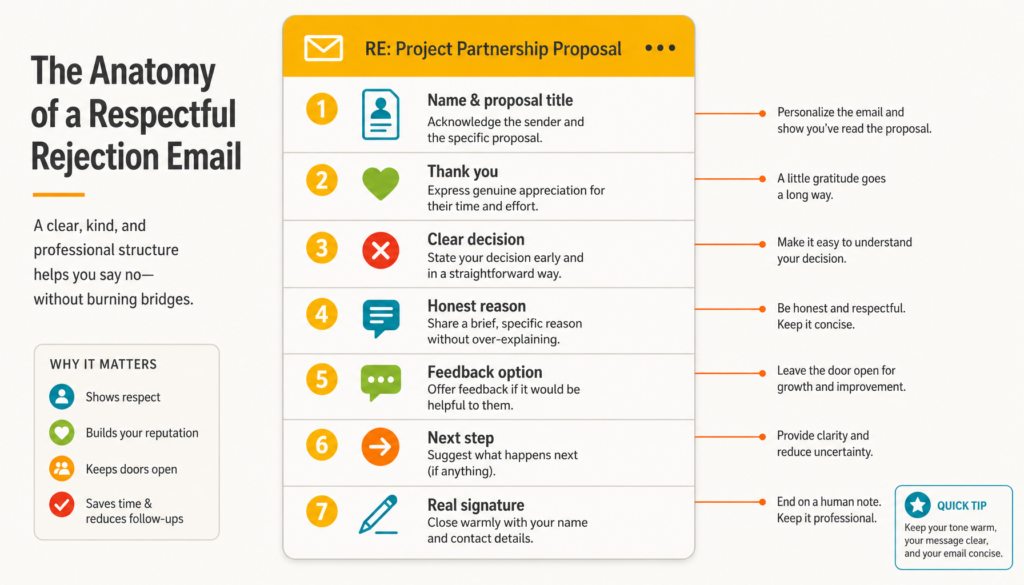
Every speaker rejection email needs the speaker’s name, thanks, a clear decision, and a real signature. Add an honest reason, a feedback option, and a next step when you can offer them. Keep it short, because a brief, accurate note reads as more respectful than a long, cheerful one.
Most weak rejections miss in one of two directions. Over-explaining invites a debate about the review, while under-explaining sounds cold. Worse still is a speaker proposal rejection whose reason doesn’t match what the panel decided.
Here’s the anatomy to reuse every time you reject a speaker proposal:
- The speaker’s name and proposal title, to show a person read it
- Thanks for the specific work submitted, to acknowledge the effort
- A clear decision in the first two sentences, to spare them a hunt for the news
- A brief, honest reason if you give one, to make the decision understandable
- Whether feedback is available and how to ask, to set expectations
- One next step, such as a waitlist, another format, attending, or reapplying, to keep the relationship open
- A real name and title in the signature, to give them a person to reply to
The Loopyah guide sets the same standard: thank the person, confirm the decision, and say whether feedback is available. It adds that any reason you give should match the record. A simple scoring rubric helps, because reviewers note reasons against the same criteria, and those reasons hold up when you repeat them.
Leave out vague praise, promises you can’t keep, and comparisons to accepted speakers. Each one hands the reader something to argue with.
Accurate reasons depend on good notes. EventMobi’s Call for Speakers keeps timestamped notes on each submission in its review workspace, so your stated reason matches what you recorded.
Speaker Rejection Email Templates for Common Decisions
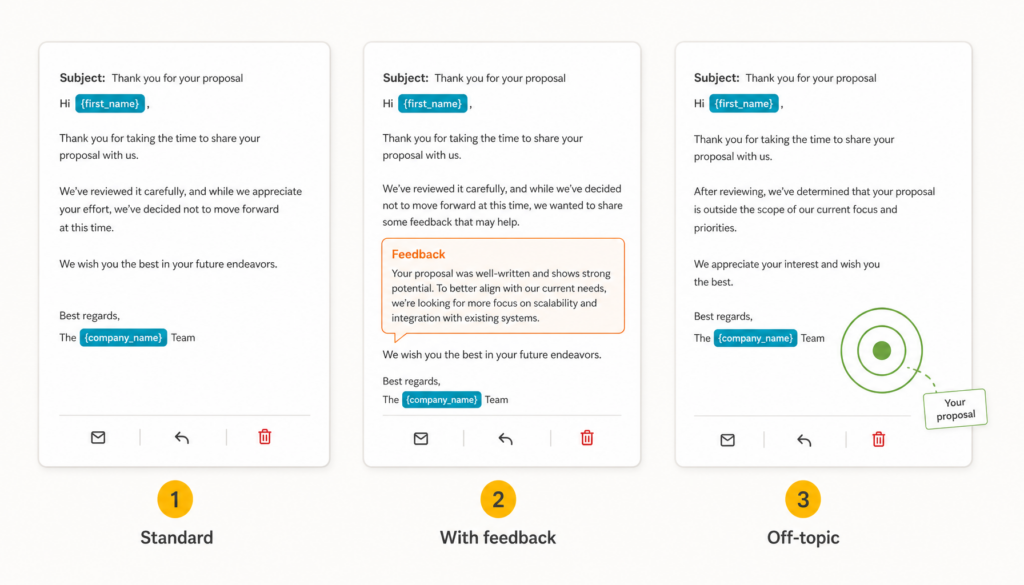
“A rejection can be direct and kind.” (Loopyah)
Three base templates handle most of the no decisions after review: a standard rejection, a rejection with feedback, and an off-topic decline. Each stays personal through tokens and one tailored line. That keeps a large send from reading like a form letter.
Writing every message from scratch isn’t realistic when proposals number in the dozens. One generic message for everyone has the opposite problem, because it reads as exactly the form rejection speakers remember. These rejection email templates sit between the two, so test every token and fallback before you send.
Template 1: Standard or High-Volume Rejection
Use this for most declined proposals, when you don’t have time for individual notes.
Subject line: Your {event_name} proposal: decision from the program committee
Hi {first_name|there},
Thank you for submitting {proposal_title|your proposal} to {event_name}. After reviewing every submission, the program committee did not select your proposal for this year’s program.
We received more strong proposals than we have session slots, and many decisions were close. If you’d like brief feedback, reply to this email and we’ll share what we can.
We hope you’ll join us as an attendee and submit again next year.
Best regards,
{organizer_name}, {organizer_title}
Template 2: Rejection With Specific Feedback
Use this when your notes support one concrete, actionable observation, and replace the example in the second paragraph with your own.
Subject line: {first_name|Hi}, feedback on your {event_name} proposal
Hi {first_name|there},
Thank you for submitting {proposal_title|your proposal} to {event_name}. The review committee has decided not to include it in this year’s program.
One piece of feedback we hope is useful: your case for peer assessment in large lecture courses was clear and well argued. We received three proposals on assessment and chose the one that included a hands-on activity for attendees.
Adding an activity like that would make a future proposal more competitive. We’d be glad to see one from you next year.
Best regards,
{organizer_name}, {organizer_title}
Template 3: Off-Topic or Not a Fit for This Program
Use this when a proposal falls outside the program’s focus and you want to say so without judging the idea.
Subject line: About your proposal for {event_name}
Hi {first_name|there},
Thank you for submitting {proposal_title|your proposal} to {event_name}. We won’t be including it in this year’s program.
This year’s annual meeting centers on {program_focus|workforce development for member organizations}, and the committee kept every session close to that theme. Your proposal sits outside that focus, and the decision reflects the program’s scope rather than the quality of your idea.
If you have a session that connects to the theme, we’d welcome it in a future call. You’re also welcome to attend.
Best regards,
{organizer_name}, {organizer_title}
Bulk sends suit the standard template, while feedback messages usually go one at a time. EventMobi’s Call for Speakers supports both, with a preview before sending and basic customization through system email templates in the Experience Manager.
Sorting a full stack of proposals into yes, no, and maybe?
EventMobi’s Call for Speakers lets you preview decision emails before they go out and shows which speakers have been notified.
Templates That Keep the Door Open for Strong Speakers
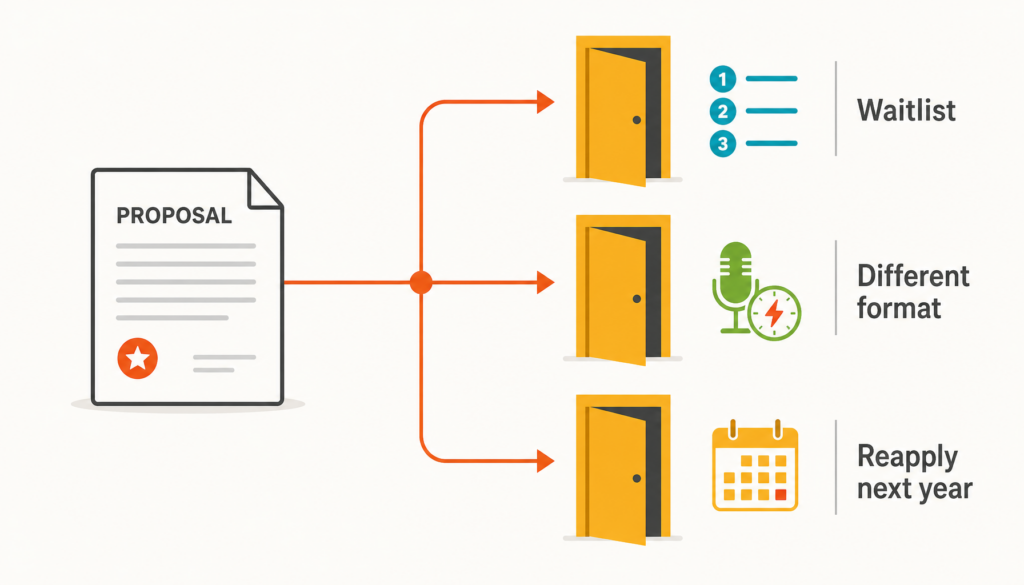
Strong proposals that just missed deserve a different kind of no. Match the door you leave open to the proposal: a waitlist spot, a different format, or an invitation to reapply. Offer only what you can deliver.
A flat rejection to a near-miss speaker can cost you later. Three weeks before the event, a confirmed speaker drops out, and the best replacement is someone you already turned down. So which offer fits which proposal?
| Proposal situation | What you offer | Template to use |
| Strong but over capacity | A waitlist or backup slot | Template 4 |
| Good idea, wrong format | A poster, lightning talk, panel, or invitation to attend | Template 5 |
| Promising but not ready | Encouragement to reapply, with the next call’s timing if known | Template 6 |
Template 4: Near-Miss or Waitlist
Use this for proposals you’d accept tomorrow if a slot opened.
Subject line: {event_name}: your proposal and our speaker waitlist
Hi {first_name|there},
Thank you for submitting {proposal_title|your proposal} to {event_name}. We couldn’t fit it into this year’s program, but it was one of the closest decisions the committee made.
With your permission, we’d like to keep you on our speaker waitlist. If a session opens before {decision_date|the final program is published}, we may contact you to offer the slot. This isn’t a guarantee, and we understand if your plans change.
Please reply to let us know whether you’d like to stay on the list.
Best regards,
{organizer_name}, {organizer_title}
Template 5: Alternate Format or Invitation to Attend
Use this when the idea is good but the format isn’t, and include the registration offer only if you offer it.
Subject line: A different way to join {event_name}
Hi {first_name|there},
Thank you for submitting {proposal_title|your proposal} to {event_name}. The committee didn’t select it as a full session, but we’d like to find another place for your idea.
We’d like to invite you to present it as {alternate_format|a lightning talk}. If that doesn’t suit you, we’d be glad to welcome you as an attendee with {registration_offer|discounted registration}.
Please reply by {reply_deadline|the end of next week} so we can plan the lineup.
Best regards,
{organizer_name}, {organizer_title}
Template 6: Encouragement to Reapply Next Year
Use this for promising proposals that need more development before they’re ready for your program.
Subject line: Thank you for submitting to {event_name}
Hi {first_name|there},
Thank you for submitting {proposal_title|your proposal} to {event_name}. We won’t be including it in this year’s program.
The topic has promise, and we’d like to see it again. A version with {improvement_note|clearer learning outcomes and a concrete example} would be more competitive.
Our next call for speakers is expected to open {next_call_date|early next year}, and we’ll email you when it does.
Best regards,
{organizer_name}, {organizer_title}
For illustration only, consider a nonprofit summit with 12 speaking slots and 60 proposals. The committee waitlists five near-misses with Template 4. When a speaker cancels two weeks out, the organizer fills the slot with one email.
That only works if the offer is real. A waitlist that never calls, or a discount that doesn’t exist at checkout, undoes the goodwill the email built.
Near-miss speakers are easy to lose track of between review and event day. In EventMobi’s Call for Speakers, you can flag them in submission notes. Changing a status doesn’t send an email, so you can accept one of those proposals later and notify the speaker when you’re ready.
When to Send Speaker Rejection Emails and How to Track Them
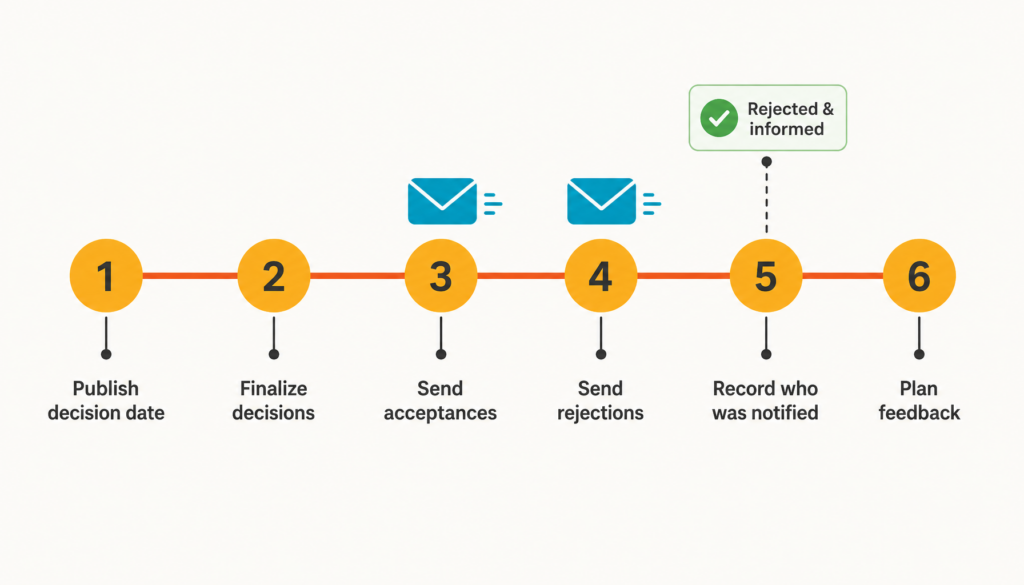
Send speaker rejection emails after every decision is final, on or before the date you published with the call. Acceptances go first, then rejections the same day or shortly after. Keep a record of who was notified and when.
Timing mistakes do the most damage. A rejection sent before the program is final, a decision reversed after the email lands, or a missed decision date all cost trust. So does a send list nobody tracked.
Follow this sequence:
- Publish the decision date with the call and keep to it
- Finalize every decision before any email goes out
- Send acceptances first, and wait for confirmations if your program depends on them
- Send rejections the same day or shortly after
- Record who was notified and when
- Decide how you’ll handle feedback requests before they arrive
The first step comes from Fränkel’s 2020 speaker view: publish the date for decision letters with the call, and stick to it. On step six, offering feedback on request is a reasonable compromise when time is tight. Make sure any feedback you share matches the reason in your rejection email.
Reliable timing also depends on knowing what actually went out. Decision emails in EventMobi’s Call for Speakers go out only when you send them, and each submission shows whether its email was sent. If a message bounces or a speaker says it never arrived, you can resend it.
Pre-Send Checklist for Speaker Rejections
- Decisions marked final
- Acceptances sent and confirmed where needed
- Tokens and fallback values tested
- Reasons checked against review notes
- Feedback plan set
- Near-miss speakers flagged for the waitlist
- Send list matched to the rejected proposals
- Sender name and reply-to address checked
Speaker Rejection Email FAQ
These frequently asked questions (FAQ) cover rejection reasons, timing, send order, and pushback from speakers.
The Bottom Line on Saying No to Speakers
A rejection is still an invitation to come back. Sent on time, clear about the decision, and respectful of the work, it keeps declined speakers in your call for speakers next year. That’s how you let speakers down gently without letting them go.
Before your next call closes, pick the templates you’ll use, publish your decision date, and decide who sends each type of message. Then turn to the speakers you did accept with EventMobi’s guide to finding, introducing, and thanking event speakers.

EventMobi’s Call for Speakers tracks every decision in one place and sends rejection emails, one at a time or in bulk, when you’re ready.
